
US inflation rose faster than expected in October, pushing up bond yields and strengthening the case for further Federal Reserve interest rate increases.
UK inflation edged up to 3.6%, but the rise came mainly from fuel and energy, while underlying measures held steady.
With oil and European gas prices beginning to fall since early November, the risk of a lasting inflation problem looks lower in the UK than in the US.
When inflation rises on both sides of the Atlantic, it is tempting to assume that the US and UK are telling the same story. Both economies have absorbed the same energy shock from the conflict in Iran, and both central banks are now raising interest rates.
In reality, the two countries are moving for different reasons. In the US, price rises are increasingly coming from within the economy, and policymakers are signalling that several more rate increases may be needed. In the UK, inflation remains largely an energy story, and energy prices have fallen sharply this month. This could ease pressure on end consumers, although the benefits may not be felt for several months. These elements will continue to shape how far each central bank is likely to raise interest rates.
This week, we look at what lies behind each country’s latest inflation figures, why the Federal Reserve (Fed) is signalling further rate increases, and what this means for portfolios.
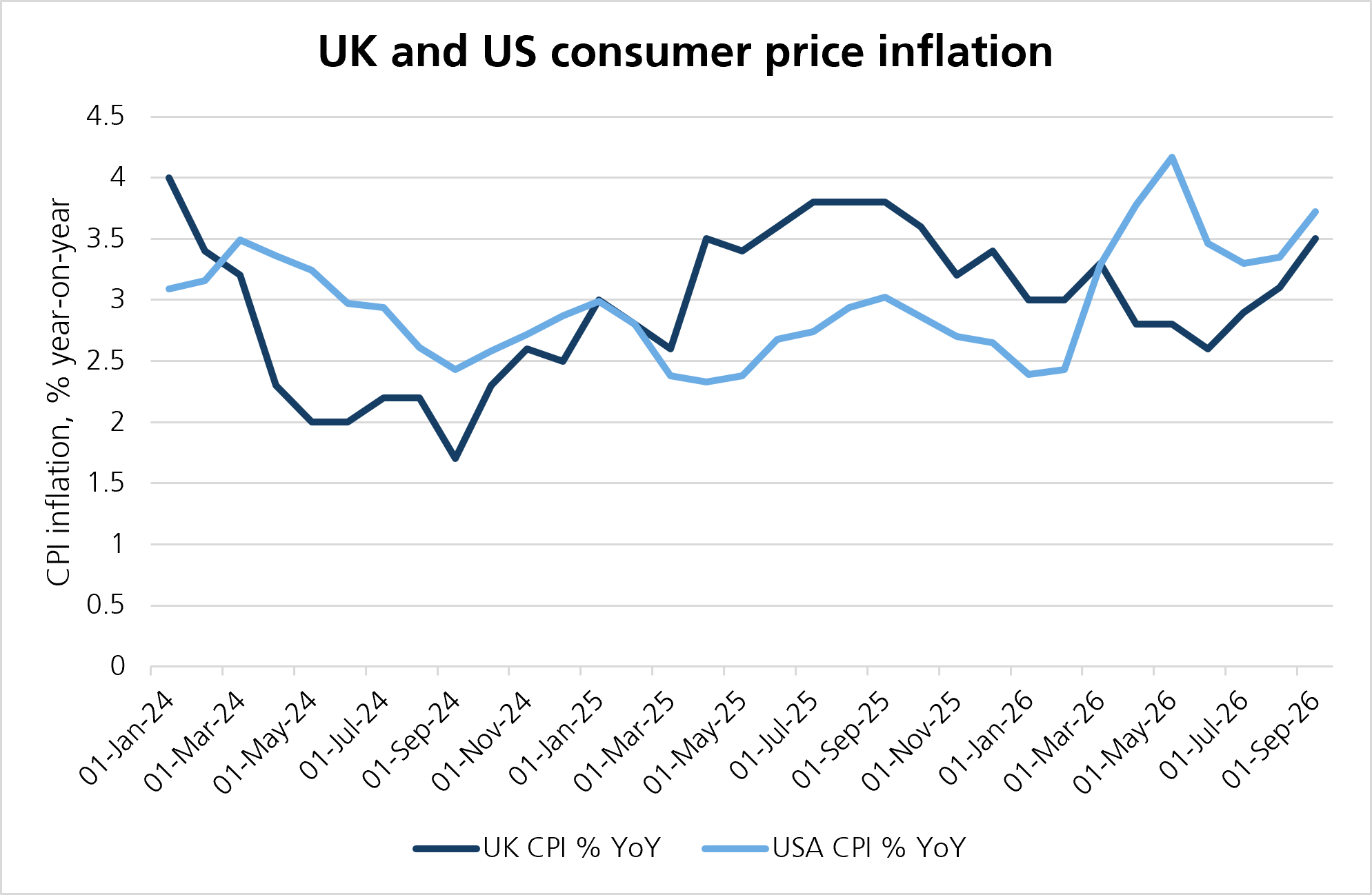
US consumer prices rose by 0.4% in October, above the 0.3% economists had expected. Core inflation – which excludes volatile food and energy prices – rose by 0.3%, ahead of forecasts of 0.2%.
The reaction in bond markets was sharp. The yield on two-year US government bonds, which closely tracks expectations for Fed policy, rose by 0.17% in a single day to 4.73%, its largest one-day increase since April 2025. The 10-year yield rose by 0.10% to 4.98%, briefly moving above 5% during the session. Government bond yields tend to rise when inflation increases, as investors anticipate that central banks may need to keep interest rates higher for longer to bring price pressures under control.
What concerns policymakers most is where the inflation is now coming from. Over the three months to October, core prices rose at an annualised pace of 3.7% their fastest pace this year. Housing costs alone accounted for more than 30% of the overall increase in consumer prices in October, while inflation remains persistent in services. Usually, these prices are largely insulated from swings in energy prices.
This presents a harder challenge than an energy price shock on its own. The impact of higher oil prices tends to fade from the inflation figures once energy markets settle. However, when rents, services and a wide range of everyday prices rise together, it suggests that inflationary pressures are becoming more widespread and entrenched. This can make inflation harder to tackle as those pressures do not ease simply because oil becomes cheaper.
Fed Governor Christopher Waller, speaking in London on the day of the data release, said he was particularly concerned about the breadth of price increases. More than 70% of service categories within the PCE price index had risen by more than 3% over the past year. He also cited research suggesting that higher energy costs may feed into wider prices more than previously thought, with the effect persisting well into 2027. Against this backdrop, Waller suggested said that the Fed should consider raising interest rates by 0.5% in their December meeting if core prices rose by 0.3% or more in October – a threshold the latest figures met.
In addition, this week, St. Louis Fed President Alberto Musalem went further, saying that “the economy will likely require several interest rate increases before the spring of 2027”. He argued that the Fed’s current range of 3.75% to 4% is as much as one percentage point below where it needs to be. Musalem does not vote on policy this year, but his comments highlight the growing concerns about the persistence of inflation.
As mentioned, the situation is significantly different in the UK. Consumer price inflation (CPI) rose to 3.6% in October from 3.5%, in line with expectations. Core inflation was unchanged at 2.8%, and services inflation, an important indicator of domestic wage and pricing pressures, held at 3.7%. Much of the increase in headline CPI came mainly from higher fuel costs, with diesel prices reaching a record 199.5p a litre.
Headline inflation is still expected to rise further over the coming months, with energy suppliers forecasting that Ofgem’s household price cap will rise by around 25% in January. Economists expect headline inflation to rise above 4% at the start of 2027.
Encouragingly, energy markets have moved in the UK’s favour in recent weeks. Brent crude oil fell from around $118 a barrel at the end of October to around $91 within a week of the US midterm elections, as markets priced in a greater chance of a diplomatic resolution to the conflict in Iran. European gas prices have also fallen by more than 20% so far this month, after having reached their highest level since 2022 in October.
These developments could provide some relief for UK inflation, though the benefits may take some time to reach consumers. Because Ofgem sets its cap on wholesale prices over the preceding months, much of January’s increase is already locked in. However, if lower prices hold, they should reach petrol pumps quickly and ease household energy bills from April.
This shapes how we read the Bank of England’s (BoE) recent decision. The BoE raised interest rates by 0.25% to 4% in November by an 8–1 vote in favour and one member preferring a larger increase. With core and services inflation stable, that rate increase looks more precautionary, than a response to inflation already generated at home.
Both central banks are raising interest rates, but for different reasons. In the US, persistent price pressures across the economy could require more rate hikes. In the UK, the BoE is acting to stop an energy price shock from becoming embedded into wages and wider prices. On balance, we believe the BoE is less likely than the Fed to need a prolonged series of interest rate increases. However, this depends on the recent decline in energy prices being sustained. A renewed escalation in the Middle East, or evidence that higher costs are becoming embedded in domestic prices, could change that outlook.
For bond investors, this reinforces the argument for being selective about where and when you take government bond exposure, rather than treating developed markets as moving together. US Treasuries may remain sensitive to expectations for further Fed tightening. In contrast, gilts could benefit if falling energy prices lead investors to reassess how far UK interest rates need to rise. Much will depend on whether lower energy costs hold and how inflation and monetary policy develop relative to what markets have priced in. Nevertheless, rising yields in either market can offer opportunities to lock in attractive levels of income.
Sources and footnotes:
LGT Wealth Management UK LLP is authorised and regulated by the Financial Conduct Authority Registered in England and Wales: OC329392. Registered office: 14 Cornhill, London, EC3V 3NR. LGT Wealth Management Limited is authorised and regulated by the Financial Conduct Authority. Registered in Scotland number SC317950 at Capital Square, 58 Morrison Street, Edinburgh, EH3 8BP. LGT Wealth Management Jersey Limited is incorporated in Jersey and is regulated by the Jersey Financial Services Commission in the conduct of Investment Business and Funds Service Business: 102243. Registered office: Sir Walter Raleigh House, 48-50 Esplanade, St Helier, Jersey JE2 3QB. LGT Wealth Management (CI) Limited is registered in Jersey and is regulated by the Jersey Financial Services Commission: 5769. Registered Office: at Sir Walter Raleigh House, 48 – 50 Esplanade, St Helier, Jersey JE2 3QB. LGT Wealth Management US Limited is authorised and regulated by the Financial Conduct Authority and is a Registered Investment Adviser with the US Securities & Exchange Commission (“SEC”). Registered in England and Wales: 06455240. Registered Office: 14 Cornhill, London, EC3V 3NR.
This communication is provided for information purposes only. The information presented is not intended and should not be construed as an offer, solicitation, recommendation or advice to buy and/or sell any specific investments or participate in any investment (or other) strategy and should not be construed as such. The views expressed in this publication do not necessarily reflect the views of LGT Wealth Management US Limited as a whole or any part thereof. Although the information is based on data which LGT Wealth Management US Limited considers reliable, no representation or warranty (express or otherwise) is given as to the accuracy or completeness of the information contained in this Publication, and LGT Wealth Management US Limited and its employees accept no liability for the consequences of acting upon the information contained herein. Information about potential tax benefits is based on our understanding of current tax law and practice and may be subject to change. The tax treatment depends on the individual circumstances of each individual and may be subject to change in the future.
All investments involve risk and may lose value. Your capital is always at risk. Any investor should be aware that past performance is not an indication of future performance, and that the value of investments and the income derived from them may fluctuate, and they may not receive back the amount they originally invested.