President Donald Trump’s first term in the White House saw unusually high staff turnover among senior aides and cabinet officials, creating a volatile backdrop for investors when assessing the administration’s priorities. In his second term, we have witnessed a shift in his governing style, as the US president has adopted a more discreet approach, favouring private negotiation and strategic appointments rather than overt personnel changes. It reminded me of the popular competition show, The Traitors, where strategic gameplay and discretion can prove more effective than display.
While public dismissals have become less frequent in Trump’s administration, policy decisions – notably the use of tariffs – have been central in influencing global trade relations. These measures have at times blurred the line between ally and competitor, serving as an economic tool that can also test alignment and exert leverage.
In the process of assessing successors to the Federal Reserve (Fed) Chairman Jerome Powell, the administration has been closely examining who might prove reliable on policies before making a final choice. The Fed was designed to be independent from the White House so officials can set rates to control inflation without political pressure. Yet institutional independence has done little to insulate the Fed from White House pressure.
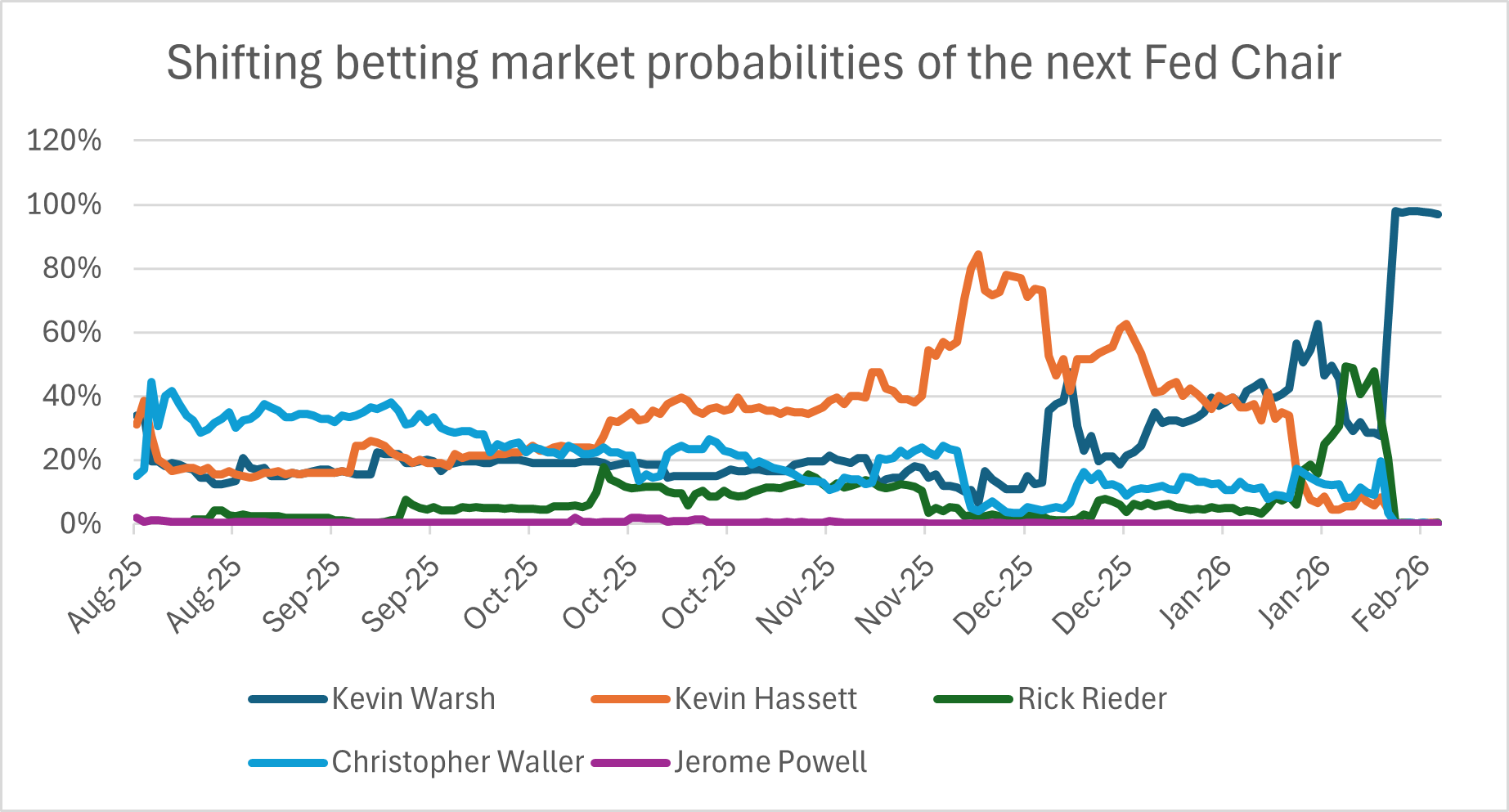
Figures such as Kevin Hassett, Kevin Warsh, Christopher Waller and Rick Rieder were all publicly floated and scrutinised, as the White House weighed up their views on interest rates and institutional independence.
At the Davos conference in Switzerland, speaking about the timing of a new Fed chair announcement at the conference, Trump said, “Problem is they change once they get the job. They said everything I want to hear and then they get the job, they're locked in for six years, they get the job, and all of a sudden, ‘Let's raise rates a little bit.’ I call them, ‘Sir, we'd rather not talk about this.’ It's amazing how people change once they have the job. It's too bad, sort of disloyalty, but they got to do what they think is right.”1
The process concluded on 30 January, when Trump announced Warsh would succeed Powell as chairman of the central bank, pending Senate confirmation, putting the former central bank governor in a pivotal position at an institution increasingly at odds with the administration.2 Warsh, who was a front-runner to be Fed chair during Trump’s first term and was a Fed governor from 2006 to 2011, currently works with Stanley Druckenmiller and is a senior fellow at the Hoover Institution at Stanford.
Following the announcement of Warsh’s appointment, we saw sharp declines in precious metals, with gold and silver giving up most of their gains this year. The dollar, which had been weakening, bounced off lows. Investor concerns about debasement appear to be fading given Warsh has previously been vocal about his opposition to asset purchases, and would likely seek to reduce the Fed's balance sheet, enabling the central bank to adopt lower interest rates.
For now, Trump appears confident that Warsh will prove faithful. In a post on Truth Social, Trump praised Warsh, saying, “He will go down as one of the GREAT Fed Chairmen, maybe the best.” He continued, “On top of everything else, he is ‘central casting’ and will never let you down.” During follow-up remarks, Trump said that while he did not get a commitment from Warsh to cut rates, he expected he would do so. “He certainly wants to cut rates, I’ve been watching him for a long time.”3
Time will tell if Warsh remains faithful to the White House or to the Fed in maintaining its independence from political power.
[1] Davos 2026: Special Address by US President Donald J Trump | World Economic Forum
[2] Trump Picks Kevin Warsh as Next Fed Chair - The New York Times
[3] Trump Picks Kevin Warsh as Next Fed Chair - The New York Times
LGT Wealth Management UK LLP is authorised and regulated by the Financial Conduct Authority Registered in England and Wales: OC329392. Registered office: 14 Cornhill, London, EC3V 3NR. LGT Wealth Management Limited is authorised and regulated by the Financial Conduct Authority. Registered in Scotland number SC317950 at Capital Square, 58 Morrison Street, Edinburgh, EH3 8BP. LGT Wealth Management Jersey Limited is incorporated in Jersey and is regulated by the Jersey Financial Services Commission in the conduct of Investment Business and Funds Service Business: 102243. Registered office: Sir Walter Raleigh House, 48-50 Esplanade, St Helier, Jersey JE2 3QB. LGT Wealth Management (CI) Limited is registered in Jersey and is regulated by the Jersey Financial Services Commission: 5769. Registered Office: at Sir Walter Raleigh House, 48 – 50 Esplanade, St Helier, Jersey JE2 3QB. LGT Wealth Management US Limited is authorised and regulated by the Financial Conduct Authority and is a Registered Investment Adviser with the US Securities & Exchange Commission (“SEC”). Registered in England and Wales: 06455240. Registered Office: 14 Cornhill, London, EC3V 3NR.
This communication is provided for information purposes only. The information presented is not intended and should not be construed as an offer, solicitation, recommendation or advice to buy and/or sell any specific investments or participate in any investment (or other) strategy and should not be construed as such. The views expressed in this publication do not necessarily reflect the views of LGT Wealth Management US Limited as a whole or any part thereof. Although the information is based on data which LGT Wealth Management US Limited considers reliable, no representation or warranty (express or otherwise) is given as to the accuracy or completeness of the information contained in this Publication, and LGT Wealth Management US Limited and its employees accept no liability for the consequences of acting upon the information contained herein. Information about potential tax benefits is based on our understanding of current tax law and practice and may be subject to change. The tax treatment depends on the individual circumstances of each individual and may be subject to change in the future.
All investments involve risk and may lose value. Your capital is always at risk. Any investor should be aware that past performance is not an indication of future performance, and that the value of investments and the income derived from them may fluctuate, and they may not receive back the amount they originally invested.