
A little over ten years ago, in September 2016, the Bank of Japan (BoJ) pledged to hold the yield on 10-year government bonds at around zero, with its main interest rate at -0.1%. Japan had struggled for decades with weak demand and persistent deflationary pressure. The BoJ had already introduced negative rates to encourage lending and spending and keeping longer-term borrowing costs low was another attempt to reach its 2% inflation target.
This year though, on 18 September, it raised that rate to 1.25%, the highest level since 1995.1 Yet, the most significant change has been in Japan's companies, which have transformed how they are governed, how they use their cash and how they reward shareholders following a decade of reforms. In this article, we look at how governance reform has reshaped corporate Japan and what it means for investors.
Former Prime Minister of Japan, Shinzo Abe's economic programme which launched in 2012, rested on “three arrows”: monetary easing, flexible government spending and structural reform. Abe sought to revive growth and break the cycle of weak demand and falling prices using near-term stimulus and reforms aimed to raise Japan’s long-term growth prospect.
The structural reform has arguably proved the most lasting, particularly in the boardroom. In 2025 for example, 98.8% of companies on the Tokyo Stock Exchange's Prime market had independent directors making up at least a third of their board, in line with the Corporate Governance Code's expectation.2
The pressure intensified in 2023, when the Tokyo Stock Exchange asked listed companies, particularly those valued below their net asset value, to report on how they would improve returns for shareholders.3 Companies have also been unwinding cross-shareholdings, stakes they hold in one another which have historically helped shield management from outside pressure. The Toyota group alone sold ¥935 billion of such holdings in the year to March 2026. With fewer friendly shareholders, investors have become more assertive, with listed companies submitting a record 139 proposals during June's various annual meetings.4 In July, a revised Corporate Governance Code went further still, asking boards to regularly examine whether their cash is being put to good use.5
Listed Japanese companies were expected to pay more than ¥20 trillion in dividends in the year to March 2026, a record high. The share of profits paid out was close to 40%, above the roughly 34% paid out by large US companies. They also announced a record ¥22.3 trillion of share buybacks in the same year, with announcements between January and May this year a further 34% higher. Record payouts show that the shift is reaching shareholders, but the longer-term test is whether companies can also reinvest at attractive returns rather than relying on distributions alone.
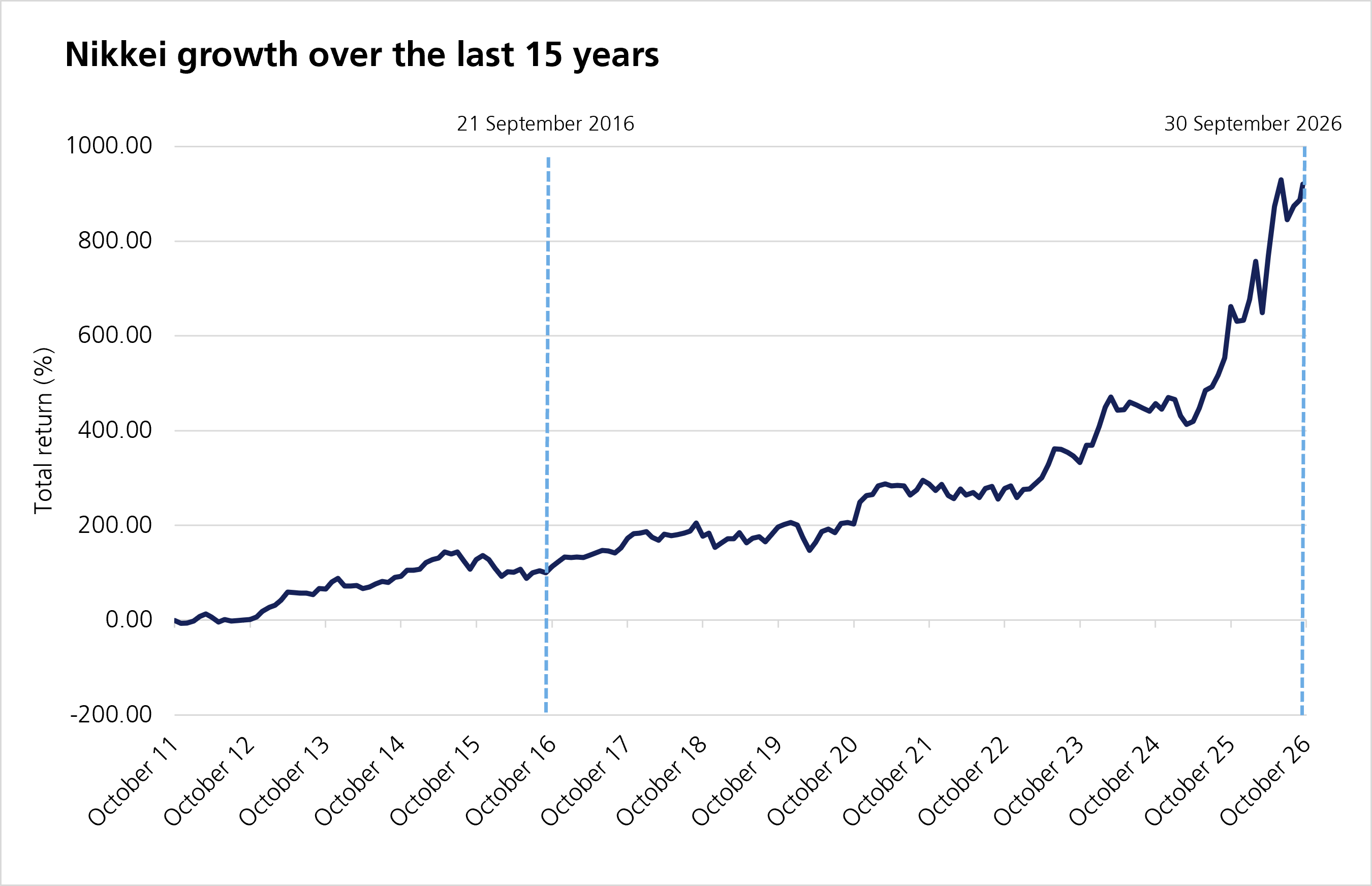
The Nikkei 225 index closed at 16,808 on the day of the BoJ's 2016 announcement, and closed at 66,754 at the end of September 2026, almost four times higher a decade later.
Japanese companies also stand out for the strength of their balance sheets. According to Bloomberg research, around 58% of listed Japanese companies hold more cash than debt, compared with roughly 31% in the UK and 20% in the US.6 These resources give many companies the capacity to continue raising dividends and buybacks. At the same time, holding large amounts of cash has historically held back the returns companies generate for shareholders, and encouraging companies to put that cash to more productive use is one of the main aims of the revised governance code.
Japan's current account, the broadest measure of its trade and investment income with the rest of the world, recorded a record surplus of ¥34.5 trillion in the year to March 2026, the third record in a row. Unlike the US and the UK, which both run current account deficits, Japan earns more from abroad than it spends.
The source of that surplus has changed. Japan is often seen as an exporter of cars and electronics, but income from overseas investments, including dividends from Japanese companies' foreign subsidiaries, reached a record ¥42.3 trillion over the year, far exceeding the ¥1.4 trillion surplus on trade in goods. That income reflects Japanese companies’ long-term expansion overseas as foreign subsidiaries and investments now provide substantial returns alongside goods exports. A weaker yen has also increased the value of those earnings when brought home. For investors, this means the Japanese market offers exposure to global growth as well as the domestic economy. We hold Japanese equities without hedging the currency because we currently view the yen as undervalued; that position also leaves returns exposed to exchange-rate movements. A stronger yen could lift unhedged returns for investors whose base currency is not yen, although it could also reduce the yen value of overseas earnings. We view the currency as a potential tailwind.
According to the International Monetary Fund (IMF), prices rose faster than the BoJ's 2% target for more than three and a half years before moderating in January.7 Wages have followed. Rengo, Japan's largest trade union federation, secured average pay rises of 5% this spring, the third consecutive year at or above 5%. For companies, rising prices and wages support revenues after decades in which neither moved, although household pay has yet to keep pace with inflation.
Against this backdrop, the BoJ has been able to begin normalising monetary policy. It ended negative interest rates in March 2024, and September's increase was its sixth in the current cycle. For equity investors, the most notable step came in January, when the BoJ began selling the stock market funds it bought during its years of easing, albeit at a pace that would take more than a century to complete.
Sanae Takaichi, Prime Minister since October 2025, argues that Japan needs proactive government spending rather than austerity.8 Her Liberal Democratic Party won 316 of 465 lower house seats in February, and her government has identified 17 strategic sectors for support, including artificial intelligence and robotics, with public and private investment projected to exceed ¥370 trillion by fiscal 2040.
Japan's transformation over the past decade is, above all, a corporate one. Companies that historically retained substantial cash and answered mainly to one another are now paying record dividends, buying back shares and facing shareholders who expect results. With governance rules still tightening and most companies holding more cash than debt, we believe this change has further to run. However, progress is uneven, which argues for being selective. The next decade will be judged by sustained improvements in productivity and returns on capital, not just by rising distributions or index levels.
LGT Wealth Management UK LLP is authorised and regulated by the Financial Conduct Authority Registered in England and Wales: OC329392. Registered office: 14 Cornhill, London, EC3V 3NR. LGT Wealth Management Limited is authorised and regulated by the Financial Conduct Authority. Registered in Scotland number SC317950 at Capital Square, 58 Morrison Street, Edinburgh, EH3 8BP. LGT Wealth Management Jersey Limited is incorporated in Jersey and is regulated by the Jersey Financial Services Commission in the conduct of Investment Business and Funds Service Business: 102243. Registered office: Sir Walter Raleigh House, 48-50 Esplanade, St Helier, Jersey JE2 3QB. LGT Wealth Management (CI) Limited is registered in Jersey and is regulated by the Jersey Financial Services Commission: 5769. Registered Office: at Sir Walter Raleigh House, 48 – 50 Esplanade, St Helier, Jersey JE2 3QB. LGT Wealth Management US Limited is authorised and regulated by the Financial Conduct Authority and is a Registered Investment Adviser with the US Securities & Exchange Commission (“SEC”). Registered in England and Wales: 06455240. Registered Office: 14 Cornhill, London, EC3V 3NR.
This communication is provided for information purposes only. The information presented is not intended and should not be construed as an offer, solicitation, recommendation or advice to buy and/or sell any specific investments or participate in any investment (or other) strategy and should not be construed as such. The views expressed in this publication do not necessarily reflect the views of LGT Wealth Management US Limited as a whole or any part thereof. Although the information is based on data which LGT Wealth Management US Limited considers reliable, no representation or warranty (express or otherwise) is given as to the accuracy or completeness of the information contained in this Publication, and LGT Wealth Management US Limited and its employees accept no liability for the consequences of acting upon the information contained herein. Information about potential tax benefits is based on our understanding of current tax law and practice and may be subject to change. The tax treatment depends on the individual circumstances of each individual and may be subject to change in the future.
All investments involve risk and may lose value. Your capital is always at risk. Any investor should be aware that past performance is not an indication of future performance, and that the value of investments and the income derived from them may fluctuate, and they may not receive back the amount they originally invested.