In June, Warner Bros. Discovery's annual meeting delivered a rare moment in corporate America: 60% of shareholders voted against the company's executive pay. This was not a minority protest vote from a select few activist shareholders, but a clear majority of the company's owners signalling to the board they had misjudged the situation. The share price had fallen, performance targets had been quietly softened and senior pay had remained largely intact. The outcome reflected a clear disconnect between pay and performance.
Warner Bros. Discovery is not held in our portfolios, but it is an illustrative example of how a vote matters. This is stewardship working as it should, a clear demonstration that listed companies are owned by their shareholders, and that ownership still carries weight.
Stewardship is the vital work that happens once capital is committed. It includes the votes we cast on behalf of clients, the questions we put to company management and the demands we make of external fund managers who invest our clients’ capital alongside us. It does not always make headlines, and a single vote rarely changes an outcome on its own, but in aggregate, it shapes how companies are run and how the risks that matter most to long-term returns are managed.
From engagements in the pharmaceutical industry on AI to understanding the risks tribal and indigenous populations face as green infrastructure build accelerates, our stewardship work goes where the issues are most material.
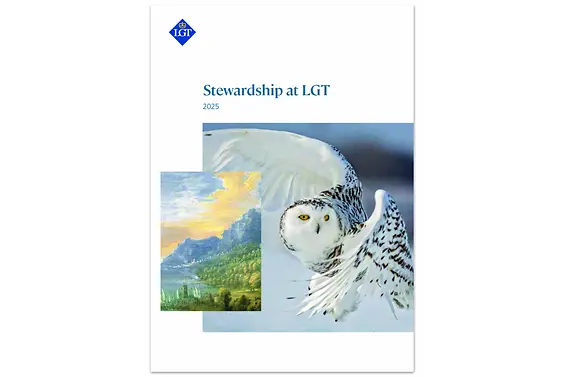
Learn how we respond in our 2025 Stewardship Report.
Many of the forces shaping markets today are not purely financial. Climate change is rewriting risk models for entire sectors. Nature loss is hitting agricultural supply chains and insurance pricing. Artificial intelligence is introducing a new category of governance risk that many boards are still learning how to oversee, and with valuations in tech-adjacent companies under pressure, active stewardship provides a mechanism to ensure these risks are being identified, questioned and addressed at board level.
How a business manages its environmental impact, its people and its technology can also shape regulatory outcomes, cash flow, valuations and long-term competitiveness. Stewardship helps ensure that companies are prepared for that reality.
Where we hold voting rights, we use them. We vote at company meetings, supporting or challenging management on matters such as board appointments, executive remuneration and shareholder rights, as well as environmental and social issues where they are financially material.
As a significant share of our clients’ capital is invested through external funds, we also assess how those managers exercise their own stewardship responsibilities.
Over the past year, we have expanded our proxy voting and introduced live vote disclosure, allowing clients to see how we vote across select portfolios and funds.
Our most significant shift has been the introduction of pass-through voting on selected passive funds. Historically, when you invested through a passive fund, the fund manager decided how to vote the underlying shares. This meant individuals’ capital might end up supporting decisions they would never endorse, cast in line with priorities that were not their own. Where available, we can now exercise those voting rights and apply our own policy, so that ownership is reflected consistently across more of our clients’ portfolios.
For a long time, nature sat in the "nice to have" column of investment thinking. With today’s datasets and information, that's no longer tenable. Water, soil, biodiversity and ecosystem stability underpin food systems, manufacturing, pharmaceutical research and a large share of the services economy. Companies in water-stressed regions are already facing higher costs and disruption, while agricultural supply chains are being reshaped by soil degradation and shifting weather patterns. Deforestation and biodiversity loss are driving tighter regulation and tangible reputational risk.
The shift in our own work over the past year has been towards precision. We're now using geospatial data and new analytical tools to pinpoint where nature-related risks actually sit within the companies and sectors our clients are invested in.
Our conversations with companies increasingly focus on specific manufacturing or packaging sites, chemical run-off into defined water basins, or sourcing policies that prioritise traceability and deforestation-free commodities at origin.
Artificial intelligence is a newer frontier. The productivity gains are real, but so are the risks: data privacy, workforce impact and questions of oversight that most boards are not yet equipped to answer. We have supported calls for clearer disclosure and stronger board-level governance, including the first wave of AI-related resolutions to reach shareholder ballots, so that these technologies are deployed thoughtfully rather than simply quickly. Stewardship on AI is not about slowing innovation. It is about making sure that companies remain investable tomorrow.
As regulation evolves and expectations rise, stewardship is likely to become even more important. It cannot be treated as a series of one-off interventions. For it to work, it requires ongoing, consistent engagement with both companies and the managers who invest capital on our clients’ behalf. Our focus will remain on the questions that matter most for our clients’ long-term wealth: whether companies are prepared for a more resource-constrained world, whether they are governed effectively and whether they are managing risks in a way that supports resilience over time.
The 2025 Stewardship Report provides a fuller picture of this work, including detailed case studies, voting activity and our oversight of external managers.
LGT Wealth Management UK LLP is authorised and regulated by the Financial Conduct Authority Registered in England and Wales: OC329392. Registered office: 14 Cornhill, London, EC3V 3NR. LGT Wealth Management Limited is authorised and regulated by the Financial Conduct Authority. Registered in Scotland number SC317950 at Capital Square, 58 Morrison Street, Edinburgh, EH3 8BP. LGT Wealth Management Jersey Limited is incorporated in Jersey and is regulated by the Jersey Financial Services Commission in the conduct of Investment Business and Funds Service Business: 102243. Registered office: Sir Walter Raleigh House, 48-50 Esplanade, St Helier, Jersey JE2 3QB. LGT Wealth Management (CI) Limited is registered in Jersey and is regulated by the Jersey Financial Services Commission: 5769. Registered Office: at Sir Walter Raleigh House, 48 – 50 Esplanade, St Helier, Jersey JE2 3QB. LGT Wealth Management US Limited is authorised and regulated by the Financial Conduct Authority and is a Registered Investment Adviser with the US Securities & Exchange Commission (“SEC”). Registered in England and Wales: 06455240. Registered Office: 14 Cornhill, London, EC3V 3NR.
This communication is provided for information purposes only. The information presented is not intended and should not be construed as an offer, solicitation, recommendation or advice to buy and/or sell any specific investments or participate in any investment (or other) strategy and should not be construed as such. The views expressed in this publication do not necessarily reflect the views of LGT Wealth Management US Limited as a whole or any part thereof. Although the information is based on data which LGT Wealth Management US Limited considers reliable, no representation or warranty (express or otherwise) is given as to the accuracy or completeness of the information contained in this Publication, and LGT Wealth Management US Limited and its employees accept no liability for the consequences of acting upon the information contained herein. Information about potential tax benefits is based on our understanding of current tax law and practice and may be subject to change. The tax treatment depends on the individual circumstances of each individual and may be subject to change in the future.
All investments involve risk and may lose value. Your capital is always at risk. Any investor should be aware that past performance is not an indication of future performance, and that the value of investments and the income derived from them may fluctuate, and they may not receive back the amount they originally invested.