
In 2023, processing a million "tokens", the basic units of AI computation, cost around $35 or £26.1 Today, some providers charge just $0.04.2 That is a 750-fold collapse in price, arguably the fastest cost deflation of any technology in history. For comparison, it took the airline industry decades to democratise flying. Artificial intelligence (AI) has achieved something similar in under three years, and the world is now using vastly more of it as a result.
But this abundance of intelligence rests on something far more old-fashioned: electricity. It is here, at the intersection of AI, energy and sustainability, that some of the most interesting investment dynamics of the decade are unfolding.
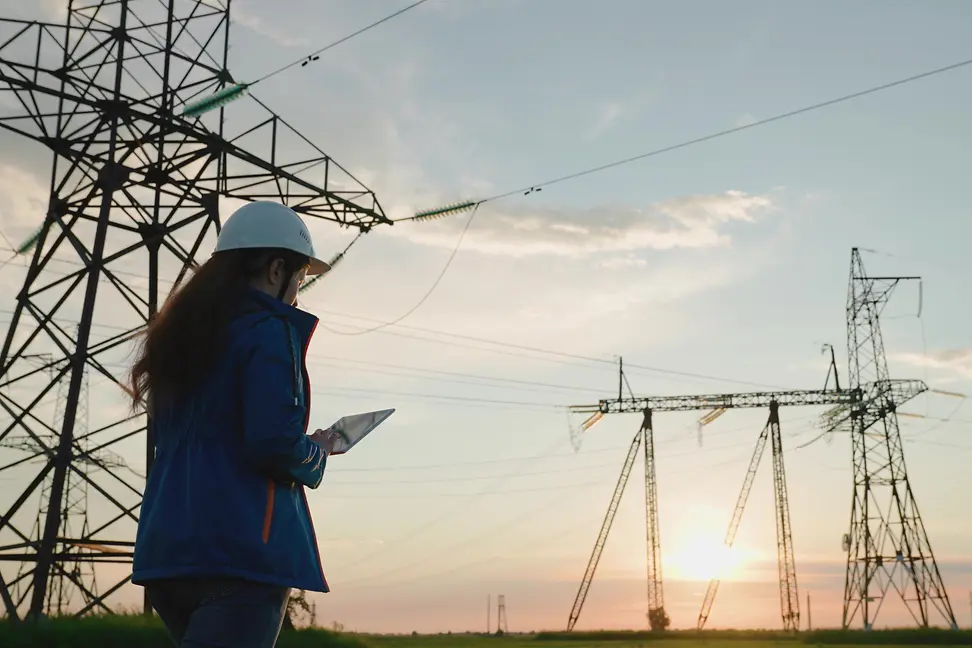
A clear shift is under way in how technology companies are thinking about energy. Once simple procurers of power purchase agreements (PPA) with utilities, the largest players are now buying and building their own energy generation outright - from Microsoft’s 20-year deal to restart the Three Mile Island nuclear plant, to Google’s $20 billion partnership to build dedicated clean energy projects. Industry analysts now describe these firms as operating as “defacto utilities” and are viewed as some of the most consequential entrants the energy sector has seen.3, 4, 5 The logic is that whoever controls the electrons controls the supply of intelligence.
With AI models becoming more mainstream, demand is only heading upwards. Many speculate the next phase of AI will not be chatbots but fully fledged agents. Agents are systems that spawn multiple sub-tasks and run continuously. Others believe we are not far from the days of physical AI, which could enter our daily lives through autonomous vehicles, like the self-driving Waymos, and robotics. Billions of machines operating around the clock represent an energy event of a magnitude the grid was never designed for.
Here is the counterintuitive part: the challenge is not the total amount of electricity AI consumes, but when it consumes it. Grids must be built to withstand their busiest moments. For example, everyone is aware of so called "TV pick up": the surge when a nation's kettles switch on at half time during a football match, or more recent energy strains like when air conditioning peaks in a heatwave. Those soaring peaks are what drive up prices for everyone, and what force expensive new infrastructure to be built.
Part of the answer is simply using intelligence more intelligently. Not every task needs the best model: a routine customer query does not require the same computational firepower as complex legal drafting or scientific research. As businesses learn to match the right model to the right job, the energy demands of everyday AI use should become far more manageable.
Another part of the answer lies in flexibility, which is why a recent UK-first demonstration6 caught our attention. At a new AI data centre outside London, National Grid, Nvidia and a pioneering company called Emerald AI demonstrated that AI facilities do not need to operate as rigid, ‘always-on’ power users. Using software that intelligently reschedules computing tasks – distinguishing the time-critical from the deferrable – the facility was able to cut its power demand by up to 40% in under a minute, and sustained lower usage for up to ten hours, without disrupting critical workloads. The trial simulated more than 200 grid events, including that famous half-time kettle surge, and met every single power-reduction target.
The implications of this study are significant. If AI data centres can flex in this way, they stop being a burden on the grid and start being an asset to it, absorbing power when renewables are abundant, easing off when communities need it most. In the United States, analysis suggests flexible AI facilities could unlock as much as 100 gigawatts of capacity that already exists on the grid today, without building a single new power station. A follow-on pilot in Silicon Valley aims to unlock a 25% increase in data centre capacity through exactly this approach.
History suggests the great energy transitions are driven less by idealism than by necessity. France built the world's cleanest grid after the 1973 oil shock left it without oil. China's dramatic pivot to renewables appears, above all, to have been an economic and security calculation. Today, the premium is on velocity and sovereignty: nations and companies want energy that is fast to deploy and free from geopolitical chokepoints such as the one evidenced by the War in Iran. It happens that clean energy, argued by some as the second fastest cost collapse after AI tokens, is now cheaper and quicker to build than the alternatives
By 2030, AI itself may be designing the batteries, optimising the factories and orchestrating the grids that power it, simultaneously creating the biggest new load on the energy system and the fastest path to energy abundance.
For investors, the message is not that AI and sustainability are competing priorities. It is that they are converging into a single story:
the companies that solve energy will most likely own the future of intelligence, and the companies that harness intelligence will transform the economics of energy.
These trends will persist beyond the medium term, and our investment team is well positioned to deploy capital as opportunities emerge.
LGT Wealth Management UK LLP is authorised and regulated by the Financial Conduct Authority Registered in England and Wales: OC329392. Registered office: 14 Cornhill, London, EC3V 3NR. LGT Wealth Management Limited is authorised and regulated by the Financial Conduct Authority. Registered in Scotland number SC317950 at Capital Square, 58 Morrison Street, Edinburgh, EH3 8BP. LGT Wealth Management Jersey Limited is incorporated in Jersey and is regulated by the Jersey Financial Services Commission in the conduct of Investment Business and Funds Service Business: 102243. Registered office: Sir Walter Raleigh House, 48-50 Esplanade, St Helier, Jersey JE2 3QB. LGT Wealth Management (CI) Limited is registered in Jersey and is regulated by the Jersey Financial Services Commission: 5769. Registered Office: at Sir Walter Raleigh House, 48 – 50 Esplanade, St Helier, Jersey JE2 3QB. LGT Wealth Management US Limited is authorised and regulated by the Financial Conduct Authority and is a Registered Investment Adviser with the US Securities & Exchange Commission (“SEC”). Registered in England and Wales: 06455240. Registered Office: 14 Cornhill, London, EC3V 3NR.
This communication is provided for information purposes only. The information presented is not intended and should not be construed as an offer, solicitation, recommendation or advice to buy and/or sell any specific investments or participate in any investment (or other) strategy and should not be construed as such. The views expressed in this publication do not necessarily reflect the views of LGT Wealth Management US Limited as a whole or any part thereof. Although the information is based on data which LGT Wealth Management US Limited considers reliable, no representation or warranty (express or otherwise) is given as to the accuracy or completeness of the information contained in this Publication, and LGT Wealth Management US Limited and its employees accept no liability for the consequences of acting upon the information contained herein. Information about potential tax benefits is based on our understanding of current tax law and practice and may be subject to change. The tax treatment depends on the individual circumstances of each individual and may be subject to change in the future.
All investments involve risk and may lose value. Your capital is always at risk. Any investor should be aware that past performance is not an indication of future performance, and that the value of investments and the income derived from them may fluctuate, and they may not receive back the amount they originally invested.