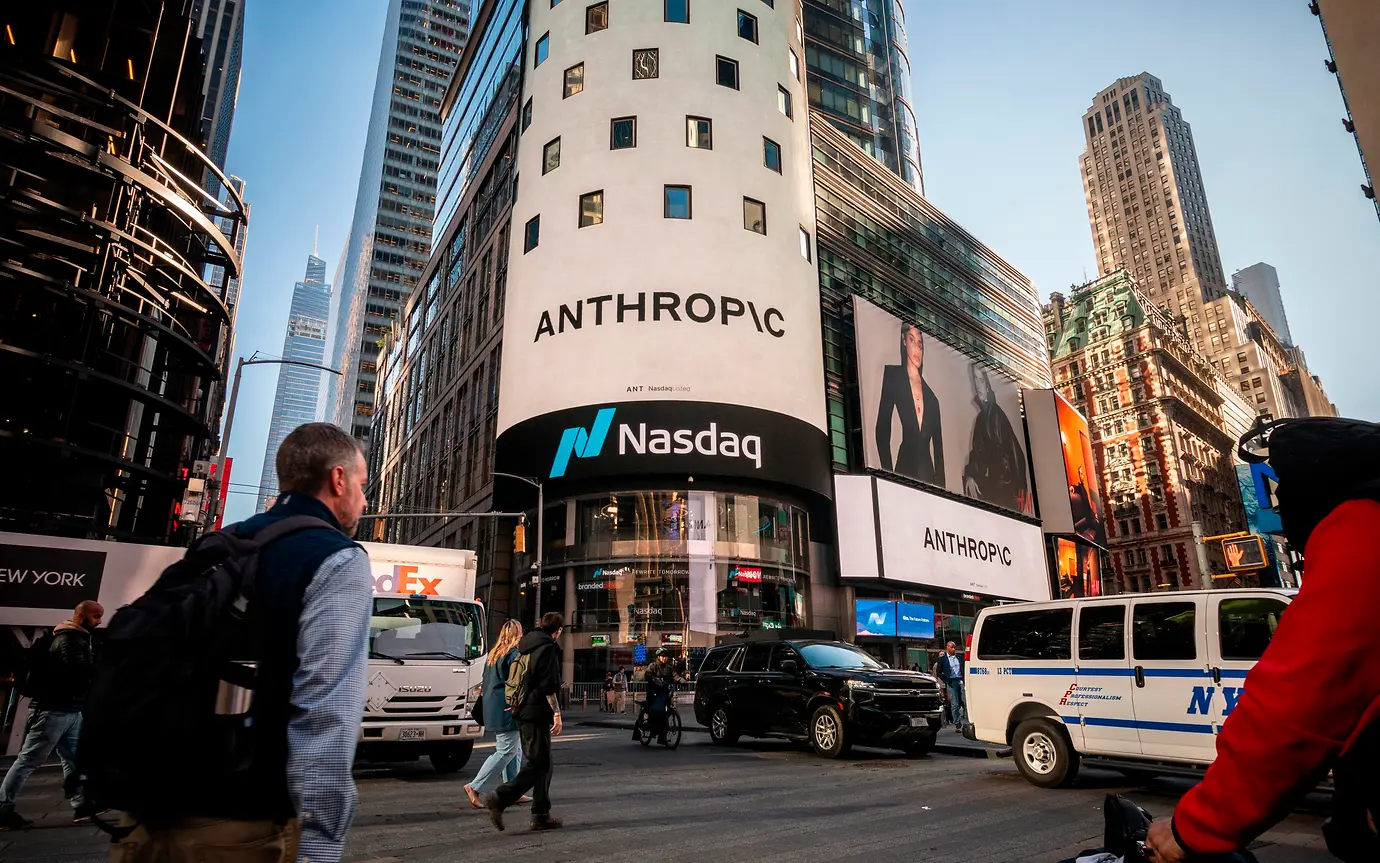
Anthropic went to market last week raising $92bn through the IPO and a further $26bn from strategic investors.
The company reported $900bn of infrastructure commitments; for investors this marks a shift towards a more capital-heavy business.
To say the last couple of weeks in markets have been eventful is a massive understatement. The danger of writing anything at the moment is that it is out of date before the ink is dry, let alone by publication. One minute the CEO of the world’s fourth largest company (Nvidia) resigns, the next he is back in charge of the second largest company in the world, which as of this sentence is the third largest.
In more normal times, this is exactly the environment that would lead sharp-suited investment bankers to advise delaying any stock market listings until “conditions are better”. On the one hand, therefore, it was surprising that the world’s largest ever initial public offering (IPO) went ahead last week amidst a difficult period for already weakening technology stocks. On the other hand, Anthropic, the AI company behind Claude, needed to list on the stock market sooner rather than later to raise the huge amounts of money required for its AI capital expenditure. Which they most certainly did, raising $92bn to list the shares on Nasdaq plus another $26bn in shares sold to the likes of Nvidia (of course), Google and other ‘strategic partners’.1
Added to the $132bn cash and equivalents the company had on hand at the end of September, Anthropic’s war chest is now $250bn.1 Even in the multi-trillion-dollar world of big tech this is a lot of money. In comparison though it’s only a third of Berkshire Hathaway's legendary cash pile, a company that’s without much of an AI angle at all (apart from their sizeable investment in Alphabet). Given Anthropic has committed $900bn to buy Nvidia’s and others’ chips and infrastructure, of which half is due before the end of 2030, one can see why achieving the IPO and bringing cash through the door, rather than worrying about the listing share price was management’s priority. Which is just as well given the share is currently trading right back at its listing price.
Even in a world full of superlatives and hyperbole, it is perfectly reasonable to refer to the company’s rise as stratospheric. Five years after its founding, Anthropic’s revenue is annualising at $80bn. Which is slightly more than HSBC’s revenue today, and HSBC was founded in 1865. Anthropic’s growth has been driven by the success of Claude.ai but has been supercharged by Claude Code which has almost completely replaced manual computer coding in under a year and a half.
We are clearly in the foothills of the AI revolution, even if many of us use AI on a daily basis (though I swear I’m writing this and not AI). Many of its uses are likely yet to be determined and the question is when, not if, the first large company built entirely from top-to-bottom by AI, will emerge. However, what is also abundantly clear is that the cost of building AI is unlike anything we have seen before (or at least not since the building of the railways). So, while Anthropic’s revenue is growing like the clappers, so are its costs.
Almost half of the company’s revenue comes via Amazon, Microsoft, and Google through their ‘cloud’ offering to customers for off-premise, state-of-the-art computer servers and services. Not only are its relationships with these companies “multifaceted and complex”,1 but they have been the ones spending hundreds of billions on AI capex rather than Anthropic, which has simply paid for usage. That $900bn of commitments is because Anthropic is now looking to build out its own infrastructure rather than piggybacking off the cloud companies. This means that pre-IPO investors were investing in a capital light business with extraordinary growth, while post-IPO investors are investing in a very capital heavy business with extraordinary growth.
And, as much as we like the business as the current leader in AI, there is a lot of inherent risk. Not the least of which is that their product is much closer to a banana than a bottle of claret (it ages quickly and badly), as it was revealed in their IPO prospectus that 80% of revenue in the latest quarter came from models released in the last six months. At LGT, we typically look for companies with durable moats that can last for decades, whereas Anthropic’s looks more like a (short) lead rather than a moat. A few questions we are asking of the company and market at the moment: what if OpenAI or other competitors launch ‘better’ models than Anthropic’s? What would that mean for the revenue Anthropic earns from its newest models? Or what if they simply price them much more cheaply?
It remains to be seen if Anthropic will be considered the ‘winner’, although it isn’t clear what winning is, or for how long winning might last. Anthropic’s masterstroke might well turn out to be having listed on the stock market now and taken in oodles of cash. Access to capital at this stage looks absolutely crucial, and as, when, or if OpenAI lists, we will all have had time to peer into the accounts of Anthropic who will have started spending the hundreds of billions of dollars on AI capex, that OpenAI might not yet have.
Has Anthropic just pulled up the drawbridge on OpenAI? Indeed, Meta – who have gone from buying back shares to issuing them – summed it up best, stating it was “important to secure capital before competitors saturate funding options”.2
LGT Wealth Management UK LLP is authorised and regulated by the Financial Conduct Authority Registered in England and Wales: OC329392. Registered office: 14 Cornhill, London, EC3V 3NR. LGT Wealth Management Limited is authorised and regulated by the Financial Conduct Authority. Registered in Scotland number SC317950 at Capital Square, 58 Morrison Street, Edinburgh, EH3 8BP. LGT Wealth Management Jersey Limited is incorporated in Jersey and is regulated by the Jersey Financial Services Commission in the conduct of Investment Business and Funds Service Business: 102243. Registered office: Sir Walter Raleigh House, 48-50 Esplanade, St Helier, Jersey JE2 3QB. LGT Wealth Management (CI) Limited is registered in Jersey and is regulated by the Jersey Financial Services Commission: 5769. Registered Office: at Sir Walter Raleigh House, 48 – 50 Esplanade, St Helier, Jersey JE2 3QB. LGT Wealth Management US Limited is authorised and regulated by the Financial Conduct Authority and is a Registered Investment Adviser with the US Securities & Exchange Commission (“SEC”). Registered in England and Wales: 06455240. Registered Office: 14 Cornhill, London, EC3V 3NR.
This communication is provided for information purposes only. The information presented is not intended and should not be construed as an offer, solicitation, recommendation or advice to buy and/or sell any specific investments or participate in any investment (or other) strategy and should not be construed as such. The views expressed in this publication do not necessarily reflect the views of LGT Wealth Management US Limited as a whole or any part thereof. Although the information is based on data which LGT Wealth Management US Limited considers reliable, no representation or warranty (express or otherwise) is given as to the accuracy or completeness of the information contained in this Publication, and LGT Wealth Management US Limited and its employees accept no liability for the consequences of acting upon the information contained herein. Information about potential tax benefits is based on our understanding of current tax law and practice and may be subject to change. The tax treatment depends on the individual circumstances of each individual and may be subject to change in the future.
All investments involve risk and may lose value. Your capital is always at risk. Any investor should be aware that past performance is not an indication of future performance, and that the value of investments and the income derived from them may fluctuate, and they may not receive back the amount they originally invested.