
In his book Pioneering Portfolio Management, the former CIO of the Yale endowment, David Swensen, helped popularise the idea that long-term portfolios should extend beyond traditional stocks and bonds to include assets linked to the real economy and alternative assets such as hedge funds.
First published in 2000, the book drew on lessons from investing across a range of market environments, including periods of elevated inflation. One of its enduring messages is that portfolios can be made more resilient by broadening their sources of return. Swensen argued that one way to do this is via real assets, which can help diversify traditional bond-equity exposures and offer some protection for purchasing power when inflation is higher.1
Real assets are investments linked to the physical economy. They typically include real estate, infrastructure, natural resources and commodities, and, in some cases, listed securities closely tied to those themes. What makes them distinctive is their connection to tangible assets, essential services and long-term demand trends. Since many real assets are linked to physical goods, replacement costs or revenues that can adjust with prices, they are often seen as better placed to keep pace with inflation – hence the term “real” assets.
The reason these assets are back in focus is that the market backdrop has changed. For much of the past two decades, investors operated in a world of subdued inflation, expanding globalisation and reliable correlations between equities and bonds. This enabled investors to create diversified portfolios by mixing both, popularising the 60/40 split strategy. However, that approach has faced challenges recently. Inflation pressures have proved stickier than many expected, while geopolitical fragmentation is reshaping trade, energy flows and supply chains.
Recent years have also been a reminder that supply can no longer be taken for granted. Since 2020, the global economy has absorbed a series of major disruptions – from the pandemic and its aftermath to energy shocks and renewed regional conflict, including the wars in Ukraine and Iran. The latest tensions involving Iran and the wider Middle East are another example of how quickly stress in strategic regions can ripple through commodity markets, transport routes and inflation expectations.
At the same time, the relationship between bonds and equities has become less consistently supportive. When inflation is low and stable, bonds can often help offset weakness in equities. But when inflation risk re-emerges, that relationship can become less dependable. In addition, rising pressure on government deficits may make sovereign bonds less reliable as portfolio shock absorbers. In that environment, assets linked more directly to physical infrastructure, pricing power, contracted revenues, or scarce resources can attract renewed attention.
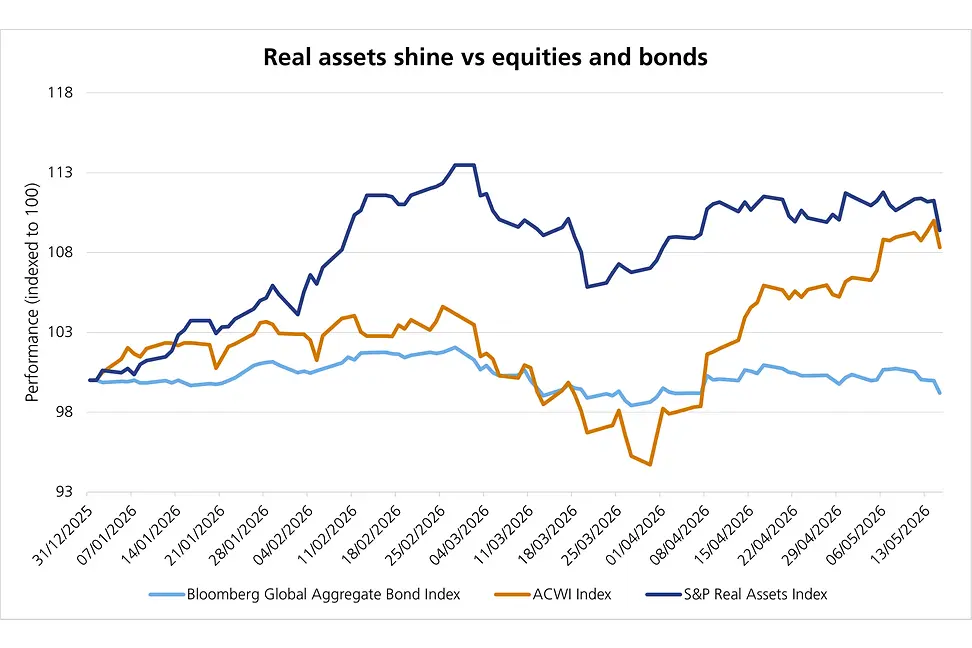
Another important driver is electrification. The shift towards more electric, digital and energy-intensive economies requires enormous investment in grids, storage, transmission, renewables, transport networks and raw materials. This is not a short-term story, but rather a structural theme likely to unfold over many years and one that touches multiple parts of the real asset universe.
The tectonic plates are shifting at both a geopolitical level, from tariffs and NATO to currency realignment, and at a technological level, namely through the rise of AI. The pace of change is unusually high. Yet when trying to make sense of major transitions, it often helps to look backward as well as forward. In that respect, Swensen’s views on alternatives and real assets look as relevant today as they did in 2000. Real assets can help protect portfolios against the uncertainty surrounding inflation, infrastructure, energy security, supply constraints, and geopolitical change. They provide exposure to parts of the economy that are likely to remain crucial over the next decade.
This does not mean they are immune from volatility. But it does help explain why they have returned to the conversation at a time when old assumptions around growth, inflation and diversification are being tested.
[1] Pioneering Portfolio Management - An Unconventional Approach to Institutional Investment, 2000, David F. Swensen
LGT Wealth Management UK LLP is authorised and regulated by the Financial Conduct Authority Registered in England and Wales: OC329392. Registered office: 14 Cornhill, London, EC3V 3NR. LGT Wealth Management Limited is authorised and regulated by the Financial Conduct Authority. Registered in Scotland number SC317950 at Capital Square, 58 Morrison Street, Edinburgh, EH3 8BP. LGT Wealth Management Jersey Limited is incorporated in Jersey and is regulated by the Jersey Financial Services Commission in the conduct of Investment Business and Funds Service Business: 102243. Registered office: Sir Walter Raleigh House, 48-50 Esplanade, St Helier, Jersey JE2 3QB. LGT Wealth Management (CI) Limited is registered in Jersey and is regulated by the Jersey Financial Services Commission: 5769. Registered Office: at Sir Walter Raleigh House, 48 – 50 Esplanade, St Helier, Jersey JE2 3QB. LGT Wealth Management US Limited is authorised and regulated by the Financial Conduct Authority and is a Registered Investment Adviser with the US Securities & Exchange Commission (“SEC”). Registered in England and Wales: 06455240. Registered Office: 14 Cornhill, London, EC3V 3NR.
This communication is provided for information purposes only. The information presented is not intended and should not be construed as an offer, solicitation, recommendation or advice to buy and/or sell any specific investments or participate in any investment (or other) strategy and should not be construed as such. The views expressed in this publication do not necessarily reflect the views of LGT Wealth Management US Limited as a whole or any part thereof. Although the information is based on data which LGT Wealth Management US Limited considers reliable, no representation or warranty (express or otherwise) is given as to the accuracy or completeness of the information contained in this Publication, and LGT Wealth Management US Limited and its employees accept no liability for the consequences of acting upon the information contained herein. Information about potential tax benefits is based on our understanding of current tax law and practice and may be subject to change. The tax treatment depends on the individual circumstances of each individual and may be subject to change in the future.
All investments involve risk and may lose value. Your capital is always at risk. Any investor should be aware that past performance is not an indication of future performance, and that the value of investments and the income derived from them may fluctuate, and they may not receive back the amount they originally invested.