This article aims to summarise both the UK State Pension and US social security benefits and also looks at the impact of the Windfall Elimination Provision (WEP) if you are entitled to benefits from both sides of the Atlantic.

To be eligible for the New State Pension in the UK, an individual needs to have a minimum of ten qualifying years. Individuals with at least 35 years will be entitled to the full basic New State Pension.
It is possible to top up your National Insurance (NI) record to purchase additional qualifying years for the UK State Pension, and this is outlined in the previous article referred to above.
Currently the age at which you can start to draw a state pension in the UK is 66, however, the age will increase from 6 May 2026 and will be age 67 by 2029. Please note that the State Pension age will be kept under review, which means it could adjust again in the future depending on various factors such as changes in life expectancy. As of the 2026/27 tax year the maximum annual benefit amounts to £12 547.60 or £241.30 per week.
If you have a UK Government Gateway ID, you can easily check your state pension record via the following website: State Pension - GOV.UK
To be eligible for Social Security, an individual must contribute to the system by paying the Old-Age, Survivors and Disability Insurance program (OASDI) tax on earned income. An individual receives one credit for each $1 810 (2025) in net earnings during the year and can earn a maximum of 4 credits per year. After attaining a minimum of 40 credits, you will qualify for a social security benefit as well as access to premium-free Medicare Part A (hospital insurance) for you and your spouse. This ultimately equals a minimum of ten years of eligible credits.
Benefits are calculated using average indexed monthly earnings. The average includes 35 years of an individual’s highest earnings and if you have less than 35 years in US earnings, the excess years get marked at zero, decreasing your average. The maximum annual benefit in 2026 at full retirement age is $49 824 per year or $4 152 per month. By setting up an account on the social security website, you can view your projected benefits and contribution history (please note you will require a US mobile phone number and US social security number to do this).
Currently, the full retirement age (FRA) is 67 for people born 1960 and later. However, you are first entitled to start drawing benefits as early as age 62 and can delay your pension until age 70. The timing of beginning your retirement benefits is important because the longer you delay, the larger the monthly benefit. By starting Social Security before full retirement age, your benefits will be permanently reduced. The chart below illustrates the impacts of collecting your pension early versus delaying with an FRA of age 67.
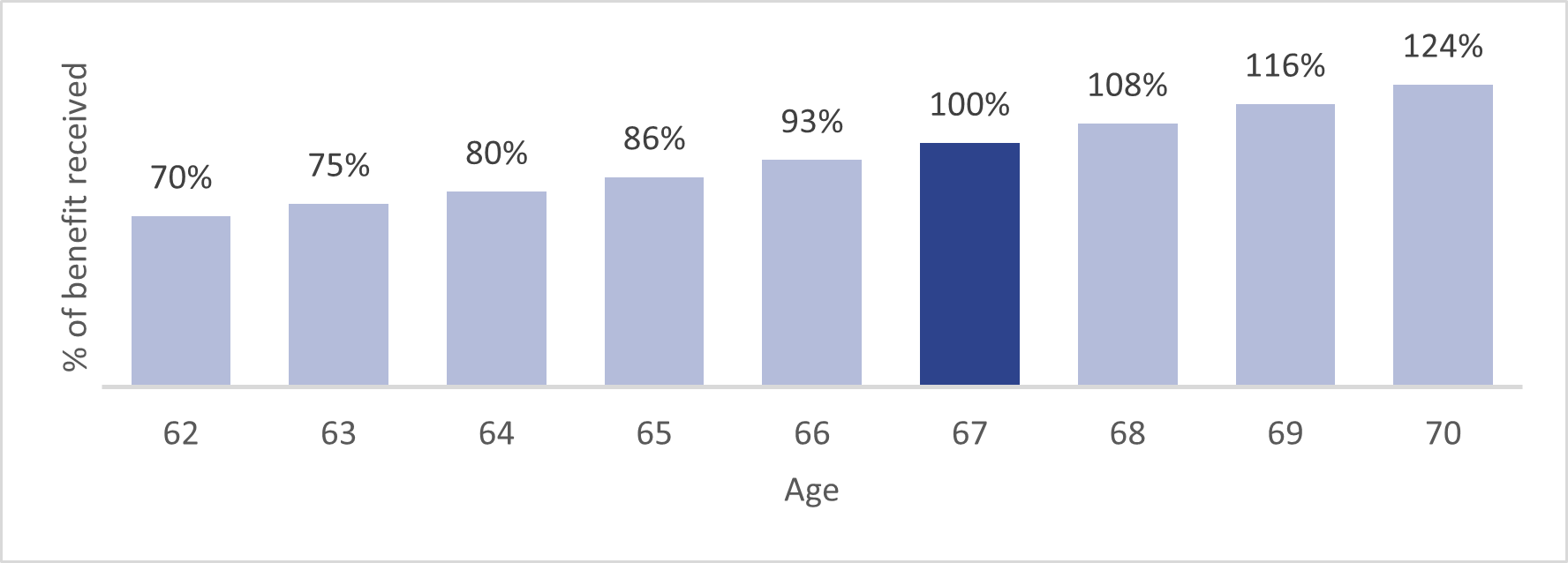
Source: SSA
The US and UK have an agreement in place to provide additional credits to reach qualification of benefits in their respective countries. This would apply to individuals who spent part of their careers in the US and UK and require gap-fill to reach the minimum requirements of ten years. Thus, allowing these individuals to still obtain a benefit due to this agreement between the two nations. In this case, the US and UK benefits will each pay out pro-rata based on the time spent working (accruing credits) in each jurisdiction.
If, over the course of your career, you have sufficient credits in each jurisdiction to be entitled to both US Social Security as well as the UK State Pension, then the WEP may have had an impact on the level of benefits you have received from your US Social Security.
On 5 January 2025, President Biden signed into law the Social Security Fairness Act which ended WEP with effect from January 2024.
As the law is retroactive, the law requires the US Social Security Administration (SSA) to adjust people’s past benefits as well as future benefits. Processing these changes is very complex and much of the work will need to be done manually and on a case-by-case basis. They will focus on processing pending or new claims for Social Security benefits and are developing procedures and automated solutions for computing retroactive benefits. It will, however, take the SSA some time to implement these changes and it will likely take more than a year for the adjustments to be made (whilst also assuming this order is not reversed by the new administration).
Due to these changes, it is important that the mailing address and/or direct deposit information that the SSA has on file is accurate so they can adjust benefits as quickly as possible. The easiest way to ensure your information is correct is via your my Social Security | SSA
We would also suggest that you do speak with your regulated financial adviser or tax adviser before making any big financial decisions.
This article was originally published on 15 March 2023 and his since been updated.
This content has been written for US connected audiences and may not be suitable for those without US financial regulatory requirements.
This communication is provided for information purposes only. The information presented is not intended and should not be construed as an offer, solicitation, recommendation or advice to buy and/or sell any specific investments or participate in any investment (or other) strategy and should not be construed as such. The views expressed in this publication do not necessarily reflect the views of LGT Wealth Management US Limited as a whole or any part thereof. Although the information is based on data which LGT Wealth Management US Limited considers reliable, no representation or warranty (express or otherwise) is given as to the accuracy or completeness of the information contained in this Publication, and LGT Wealth Management US Limited and its employees accept no liability for the consequences of acting upon the information contained herein. Information about potential tax benefits is based on our understanding of current tax law and practice and may be subject to change. The tax treatment depends on the individual circumstances of each individual and may be subject to change in the future.
All investments involve risk and may lose value. Your capital is always at risk. Any investor should be aware that past performance is not an indication of future performance, and that the value of investments and the income derived from them may fluctuate, and you may not receive back the amount originally invested.
LGT Wealth Management US Limited is a registered Company in England & Wales, registered number 06455240. Registered Office: 14 Cornhill, London EC3V 3NR. LGT Wealth Management US Limited is Authorised and Regulated by the UK Financial Conduct Authority and is a Registered Investment Adviser with the US Securities and Exchange Commission.

Swaati is responsible for heading up our Wealth Planning Department at LGT Wealth Management US. She has worked in the financial services industry for over 15 years and is a Chartered Financial Planner, a Chartered Member of CISI, and is also a Fellow of the Personal Finance Society. Swaati graduated from Southampton University with a MSc in International Financial Markets and a BSc in Economics and Finance.
Swaati has experience advising high and ultra-high net worth individuals and families providing specialist advice across all areas of wealth planning, including pension advice, wealth structuring, retirement income funding, and intergenerational wealth planning.